
When people ask “What is polyamory?”, it’s not surprising that there can be some confusion.
Some people guess that it means any kind of non-monogamy. In reality, the word has carried more pointed meanings ever since it was coined independently by two women activists for ethical multi-relationships in 1990 and 1992.
To these inventors of the word, and to polyfolk ever since, “polyamory” connotes multiple romantic relationships carried out with certain assumptions and ideals: of honesty and clear agreements among partners, mutual good will and respect among all involved, intense interpersonal communication, and high ethical standards. These ideals may or may not always be achieved in practice. But as the Wikipedia entry for polyamory succinctly puts it, “an emphasis on ethics, honesty, and transparency all around is widely regarded as the crucial defining characteristic.”
One way of looking at it is that a network of poly lovers usually tends to assume “we’re all in this together,” in terms of desire for good outcomes for everyone, even if many of the actual interlinks in the network barely exist.
Polyamory first entered mainstream dictionaries in 2006. Merriam-Webster’s Collegiate Dictionary seemed to do little research and simply came up with “the state or practice of having more than one open romantic relationship at a time.” The definitive Oxford English Dictionary traced the word’s origin, corresponded with the first of its two inventors, and incorporated some of her phrasing: “…the custom or practice of engaging in multiple sexual relationships with the knowledge and consent of all partners concerned.”
That was Morning Glory Zell-Ravenheart (1990). The other was Jennifer L. Wesp in 1992. Although they were apparently unaware of each other, both were activists for ethical multiple relationships where all involved know and consent to the interlaced partnerships. Zell had long been involved in serious group marriage. People before then had used such various terms as ethical non-monogamy, polyfidelity, waterbrotherhood, “the Harrad Experiment lifestyle,” synergamy, and loving more (from which Loving More derived its name in the early nineties). Most of these were a bit of a mouthful, and polyfidelity excluded people in more open forms of multi-partnered relationships.
“Polyamory” was a simple term as easily said as monogamy. For this reason the term took off among the community of people practicing open, honest non-monogamous relationships. It was intended to differentiate emotionally connected relationships from simple coupling, casual dating around, or recreational sex; it literally means “many loves.” By contrast, “swinging” in its strictest sense refers to people swapping partners for sexual fun. Both terms fall under the broader category of “open relationships,” and both share a belief in honesty, integrity and consent of the adults involved. In reality there is a certain amount of overlap, and both swinging and polyamory can be wonderful and caring ways to experience connection and relationships.
 So: polyamory refers to emotionally connected relationships openly involving three or more people. It is about honesty, integrity and respect. Some examples of poly relationships: A married couple might have other emotionally connected partners. Three, four or more people might all live together bonded as a family, raise children and have emotional and sexual connections between all or some combinations within the group. Someone might have several distant romantic partners they see only occasionally.
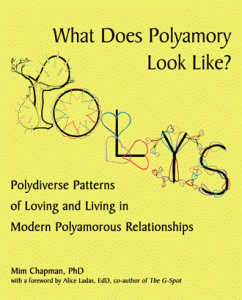
If it sounds complex, that’s because it can be as complicated as the emotions and connections involved. A polyamorous relationship is very much a design-it-yourselves project. This is one reason why polys put such stock in abundant, honest communication — and why it can all look pretty confusing. In her book What Does Polyamory Look Like?, longtime practitioner Mim Chapman describes five of the more common patterns in which people live polyamorously. This book is highly recommended to anyone looking to understand the complexities, and the different types of relationship ideals you may encounter in the community.
 Poly is becoming a way for people to explore relationships on many levels. It can provide a place to be open to romantic and sometimes platonic love in its many forms and even to the gray areas of love, sex and relationship. Love is fluid and changing, and so is sexuality for most people. Polyamory allows space for growth, change and exploration.
Some people feel that they are innately oriented to polyamory — or to monogamy — similar to a straight or gay sexual orientation. For others, poly is a deliberate philosophical choice that makes sense, just as some choose monogamy. Some may explore poly and find it is not for them, but are often glad for the experience and what they learned.
The next time you are confused about what polyamory means, remember what it stands for: many loves. Love should mean caring for people. All people. Beyond that is a world of differences and ways of living and loving as unique as the individuals involved.
If you are new to the concept of polyamory, the best thing you can do is read, discuss, explore and learn. Read books, read articles (starting right here!), read news coverage, and meet the people in your local poly discussion and support group(s). Loving More staff are available by phone Monday through Friday, 9 a.m. to 6 p.m. and even some Saturdays to answer questions and listen to concerns.
Polyamory is challenging and wonderful all at the same time, and like many things in life it is the ride that counts, not the destination and not even the definition.
Page Authors: Robyn Trask and Alan M.
Copyright 2013